
How Does Risk Management Affect Business Decision-Making?
How risk management improves business decisions: outcome ranges, risk appetite, mitigation options and a simple decision template, with real examples.
9 min read
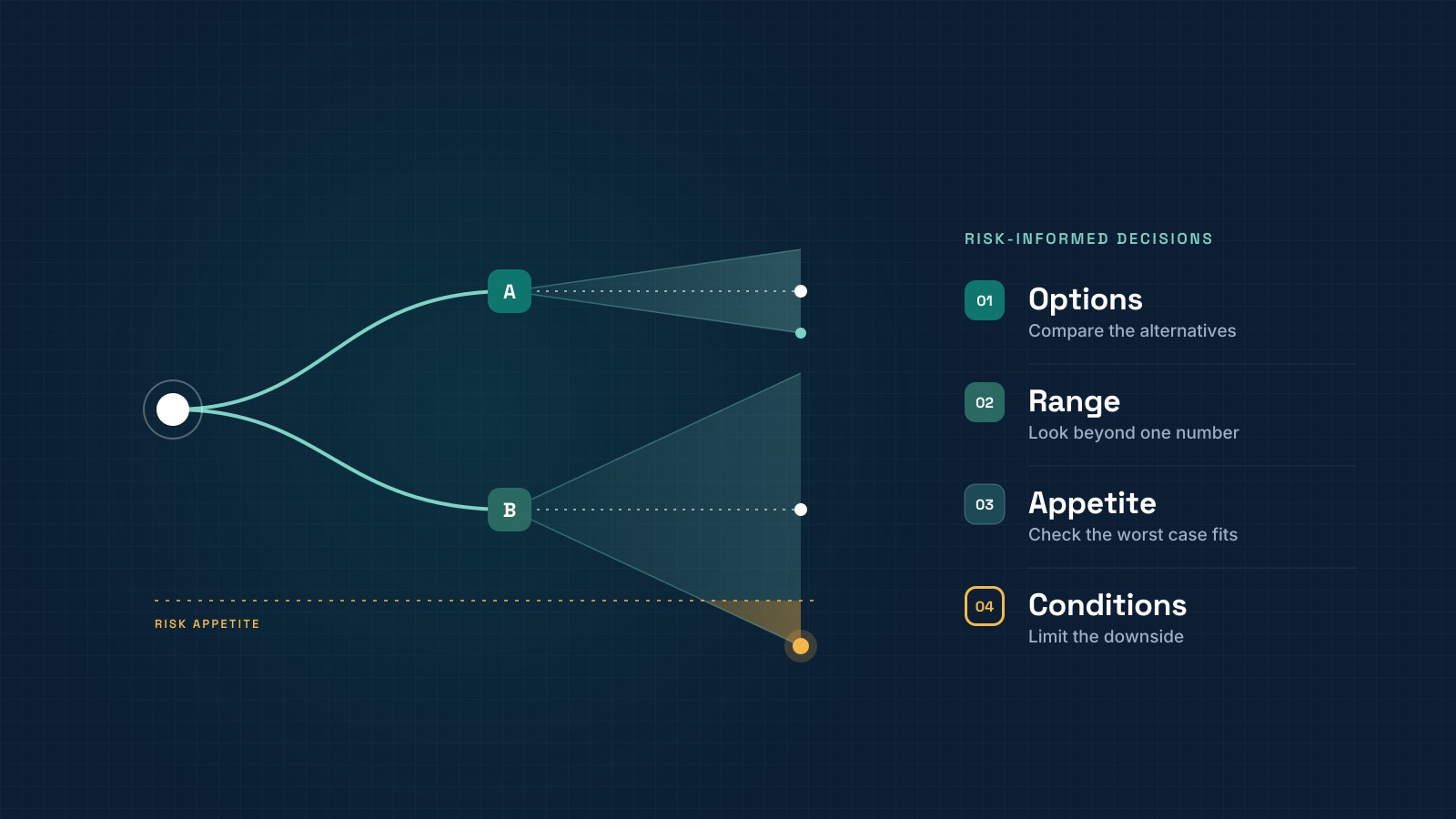
Two investment proposals reach the same board meeting. Both promise a return of around €3 million a year. The first is an extension of an existing product line. The second is a new market entry with a one-in-three chance of losing the full €10 million investment. Presented as a single number each, they look the same. Presented with their risks, they are completely different decisions.
That is what risk management adds to decision-making. Not a veto, and not more paperwork, but a clearer picture of what could happen, how bad it could get, and whether the organisation is willing to accept that.
This article shows how risk management improves the main types of business decisions, with examples from strategy, investment, operations, compliance, innovation and crisis response, and how to build risk into your decision process.
What does risk management add to a decision?
Most business cases show one expected outcome. Risk management adds four things that a single number hides:
- The range of outcomes: best case, expected case and worst case, not just the most likely result.
- The fit with risk appetite: whether the worst case is something the organisation can and wants to absorb. See how to turn risk appetite into limits.
- Options to reduce the downside: pilots, limits, insurance, contract terms or exit points that make a risky option acceptable.
- A record of the trade-off: who accepted which risk, and why, so the decision can be reviewed later.
The major frameworks put it the same way. ISO 31000 describes risk management as a way to improve planning and decision-making, and COSO's enterprise risk management framework includes evaluating alternative strategies as one of its principles. For the basics, see what is risk management.
How does it improve strategic decisions?
Strategic decisions, such as entering a market, launching a product or acquiring a company, carry the largest risks and are the hardest to reverse. Risk management makes the assumptions behind them visible and tests what happens if they are wrong.
Example: A Swiss insurer considers entering the German market with a budget of €25 million. The business case assumes 40,000 customers in three years. A scenario analysis shows that at 20,000 customers the venture loses €8 million, and that the biggest driver is not demand but the time needed for local licensing. The board approves the entry in two phases: €6 million for licensing and a pilot region, with the rest released only if the pilot reaches 5,000 customers in 12 months.
- Test the key assumptions: identify the two or three assumptions the plan depends on most, and model what happens if they fail.
- Stage big commitments: release money in phases, tied to milestones.
How does it shape investment and capital decisions?
Comparing investments on expected return alone favours the riskiest projects. Adding risk to the comparison shows which returns are worth the exposure.
Example: A bank has €20 million to invest. Project A offers an expected 12% return with a worst case of a 5% loss. Project B offers 18%, with a worst case that wipes out the full investment. On return alone, B wins. Adjusted for risk and checked against the bank's appetite, A is the better use of capital, and B is only approved at a smaller size of €5 million.
A strong balance sheet also creates options when others have none. Looking back on 2008, JPMorgan Chase's chief executive wrote that the bank's strong balance sheet, general conservatism and focus on risk management helped it get through the crisis. The bank still reported $5.6 billion of net income that year, and was able to take over Bear Stearns and Washington Mutual.
How does it improve operational decisions?
Day-to-day decisions about suppliers, systems, processes and staffing add up. Risk management helps teams see where an efficient choice creates a hidden single point of failure.
Example: A retailer can save €400,000 a year by moving all logistics to one provider. A risk review shows that a two-week disruption at that provider would cost around €3 million in lost sales. The retailer moves 70% of volume to the new provider, keeps 30% with a second one, and still saves €280,000 a year with far less exposure.
- Look for concentration: one supplier, one system or one key person.
- Price the disruption: compare the saving with the cost of the worst realistic outage.
Why should compliance risk shape decisions early?
Compliance risk is cheapest to manage when it is part of the decision, not a check at the end. Decisions about new products, markets and customers all carry regulatory requirements, and ignoring them can cost far more than the business they bring.
Example: In 2012, HSBC agreed to pay $1.92 billion to settle US money-laundering and sanctions investigations. US regulators had already ordered the bank to improve its monitoring of suspicious transactions in 2003 and again in 2010. Decisions to grow in high-risk markets were not matched by decisions to invest in the controls those markets required.
- Involve compliance at the start: before a product or market decision is final, not after.
- Treat regulator warnings as decision triggers: they should change priorities and budgets, not just produce a response letter.
Can risk management help innovation?
Yes, when it sets conditions instead of saying no. Most new ideas carry risks that can be limited with the right safeguards. A clear risk check lets good ideas move faster, because decision-makers know the downside is contained.
Example: A bank wants to launch instant loans approved by an automated model. Instead of blocking it, the risk team sets three conditions: a limit of €5,000 per loan, a maximum of €2 million in total during the first six months, and a weekly review of default rates. The product launches in eight weeks. When defaults stay below plan, the limits are raised.
- Agree conditions, not yes or no: limits, pilots and review points. See risk management vs risk mitigation.
- Define the exit: agree upfront what results would pause or stop the initiative.
How does it speed up decisions in a crisis?
In a crisis, there is no time for long analysis. Organisations that have thought through scenarios in advance can decide in hours instead of days, because the options and decision rights are already agreed.
Example: An airline's crisis playbook sets out in advance what happens if bookings drop by more than 30% in a month: which routes are reduced first, which costs are frozen, and who decides. When demand suddenly collapses, the management team activates the plan within two days instead of debating it for weeks.
- Prepare decision playbooks: for your most severe plausible scenarios.
- Agree decision rights: who can decide what, and up to which amount, in a crisis.
Why does ethical risk belong in decisions?
Some decisions are legal and profitable in the short term but carry serious ethical and reputational risk. Making that risk explicit gives people a legitimate way to raise concerns before a decision is made.
Example: Volkswagen's decision to use software that cheated emissions tests in diesel cars turned into one of the most expensive corporate scandals on record. The company now puts the total cost at around €33 billion. An honest assessment of the ethical and compliance risk would have shown a downside far larger than any benefit.
- Ask the headline question: "How would this decision look on the front page?"
- Make it safe to object: people need a channel to raise ethical concerns without career risk.
How do you build risk into your decision process?
The simplest way is a standard decision template for significant decisions, for example anything above €250,000 or with a regulatory impact. It asks the same questions every time:
- Options: what are the alternatives, including doing nothing?
- Outcomes: what are the best, expected and worst cases for each option?
- Appetite: does the worst case fit within our risk appetite?
- Mitigation: what would reduce the downside, and at what cost?
- Ownership: who accepts the remaining risk?
- Review: when do we check whether the decision is working?
Keeping these templates in a decision log turns individual choices into organisational learning: you can see which risks you accepted, which ones materialised, and whether your estimates were realistic.
How do the pieces fit together?
Risk appetite sets the boundaries. Risk assessment shows where each option sits within them. Mitigation options turn risky ideas into acceptable ones, and clear ownership makes sure someone is accountable for the risk that remains. Reviewing past decisions improves the next round of estimates.
Done well, this builds confidence among investors, regulators, customers and staff, because decisions are visibly based on a clear view of risk, not on optimism.
Where do teams get stuck?
- Risk as a late sign-off: if risk is checked after the decision is made, it can only block, not improve.
- One number per option: expected values without ranges hide the decisions that matter most.
- No clear appetite: without agreed limits, every risk discussion becomes a matter of opinion.
- Risk teams that only say no: they quickly get left out of the conversation.
- No follow-up: decisions that are never reviewed teach the organisation nothing.
How do you measure whether it's working?
- Coverage: share of significant decisions that went through the risk template.
- Timing: share of decisions where risk input came before the final proposal, not after.
- Estimate accuracy: how often outcomes stayed within the predicted range.
- Accepted risks: number of documented risk acceptances, with named owners and review dates.
- Surprises: major losses from risks that were never discussed in the original decision.
- Speed: time from proposal to decision, to check that risk input helps rather than slows.
To track accepted risks after the decision, see how to build key risk indicators.
What do frameworks and regulators expect?
ISO 31000 and COSO's enterprise risk management framework both treat risk management as part of planning and decision-making, not as a separate compliance exercise.
For financial institutions, supervisors expect the link to be formal. The Financial Stability Board's principles for risk appetite frameworks say a firm's risk appetite statement should be linked to its strategic, capital and financial plans. In Switzerland, FINMA Circular 2023/1 requires the board to approve the tolerance for operational risks at least once a year, taking into account the institution's strategic and financial goals.
Where does Risk Navigator fit?
Good decisions need current risk information at the moment they are made: which risks are rising, which controls are weak, which KRIs are red and which risks have already been accepted elsewhere.
Risk Navigator adds a layer on top of your existing tools that brings this information together, so decision-makers can see the relevant risks, controls and indicators before they commit, and track accepted risks afterwards.
In short
- Look beyond one number: compare options on their range of outcomes, not just the expected return.
- Use appetite as the boundary: worst cases must fit what the organisation can absorb.
- Set conditions, not vetoes: limits, pilots and stages make risky ideas workable.
- Bring risk in early: in strategy, investment, operations, compliance and ethics.
- Record and review: a decision log turns choices into learning.
Where can you read the source texts?
- Risk management and decision-making: ISO's overview of ISO 31000:2018 Risk management – Guidelines.
- Evaluating alternative strategies: COSO, Enterprise Risk Management – Integrating with Strategy and Performance, Executive Summary (2017).
- Risk appetite linked to strategy: FSB Principles for an Effective Risk Appetite Framework (2013).
- FINMA operational risk tolerance: FINMA Circular 2023/1 "Operational risks and resilience – banks".
- JPMorgan Chase in 2008: JPMorgan Chase, 2008 letter to shareholders.
- HSBC settlement: Insurance Journal, "HSBC to Pay Record $1.9 Billion U.S. Fine" (2012).
- Volkswagen costs: DW via Yahoo News, "Dieselgate: Volkswagen's emissions scandal troubles are far from over".
Want decision-makers to see the relevant risks before they commit? Talk to us about adding Risk Navigator on top of the tools you already use.